Classroom, rows of desks
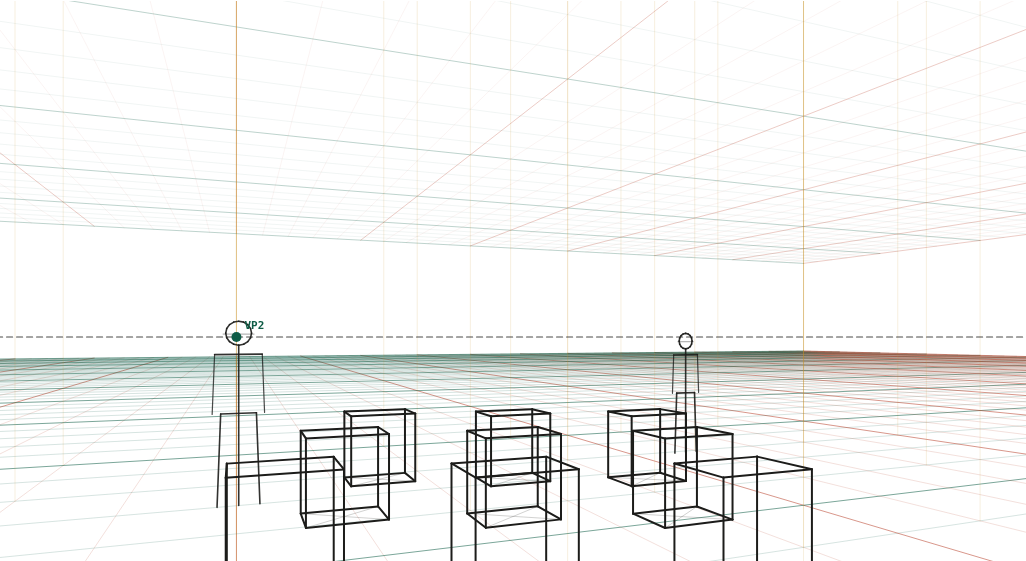
Nine desks in three rows with two standing figures, seen from a corner at 24 mm.
What to look at
Repeated equal objects are the clearest lesson in diminution: each row of desks is smaller and closer together than the last.
Both figures' eyes are on the horizon because they stand on the same floor as the camera; the shorter one's head sits a little lower.
The desk tops (0.75 m) are all below eye level, so every one shows its top surface.
What this scene is for
Nine identical desks in three rows are the cleanest test of whether you can repeat an object into depth. Use it for classrooms, offices, waiting rooms, canteens, theatre seating and any grid of equal furniture — and use the two figures to check that your desks are the right height against a person.
The mistake it settles
Making each row smaller but keeping the rows evenly spaced, which reads as a staircase rather than a floor. Both the size and the gap must shrink together. The floor squares under the desks do that arithmetic for you.
The camera
| Lens | 24 mm on full frame |
| Camera height | 1.6 m above the floor (standing) |
| Rotation | 22° to the scene's axes |
| Tilt | level (verticals stay vertical) |
| Objects | 9 × 0.7 × 0.5 × 0.75 m block · 1.75 m figure · 1.65 m figure |
| Floor | 1 m squares |
Measured off this render
Taken from the same camera model the tool draws with, on the 1340 × 754 PNG above.
| Angle of view | 73.7° across (24 mm on full frame) |
| Horizon | 452 px from the top, 60% of the image height |
| Depth-axis vanishing point | 309 px from the left edge |
| Width-axis vanishing point | 1,541 px beyond the right edge |
| Object | Distance | Height on the render | Below the horizon |
|---|---|---|---|
| 0.7 × 0.5 × 0.75 m block | 4.5 m | 149 px | all of it |
| 0.7 × 0.5 × 0.75 m block | 4.7 m | 149 px | all of it |
| 0.7 × 0.5 × 0.75 m block | 6.1 m | 110 px | all of it |
| 0.7 × 0.5 × 0.75 m block | 6.3 m | 110 px | all of it |
| 1.75 m figure | 7 m | 241 px | 91% |
Draw it from these numbers
- Rule the horizon across the sheet at 60% of the picture height — 452 px down on this 754 px render. Every other line in the scene is measured from it.
- Two vanishing points on that line: 309 px from the left edge, and 1,541 px beyond the right edge — far enough out that you should match the grid angles instead of chasing it.
- Set the scale from the 1.75 m figure at 7 m: 241 px tall, with 91% of it below the horizon. That share is the camera height divided by the object's height (1.6 ÷ 1.75 m), and it is the same for every object of that height anywhere in the picture.
Open the reference in the tool to move the camera, change the lens, or add your own objects at real sizes; the share link keeps your version. Draw over the PNG at 30–50% opacity in any app with layers.
Question
How do I copy one desk backwards into a row?
Draw the first desk on the grid, then use its diagonals: a line from the top of the near leg through the midpoint of the far side lands on the base of the next desk. Repeat and the spacing takes care of itself. The grid squares in this reference are the visible version of the same trick.