Bedroom, two-point
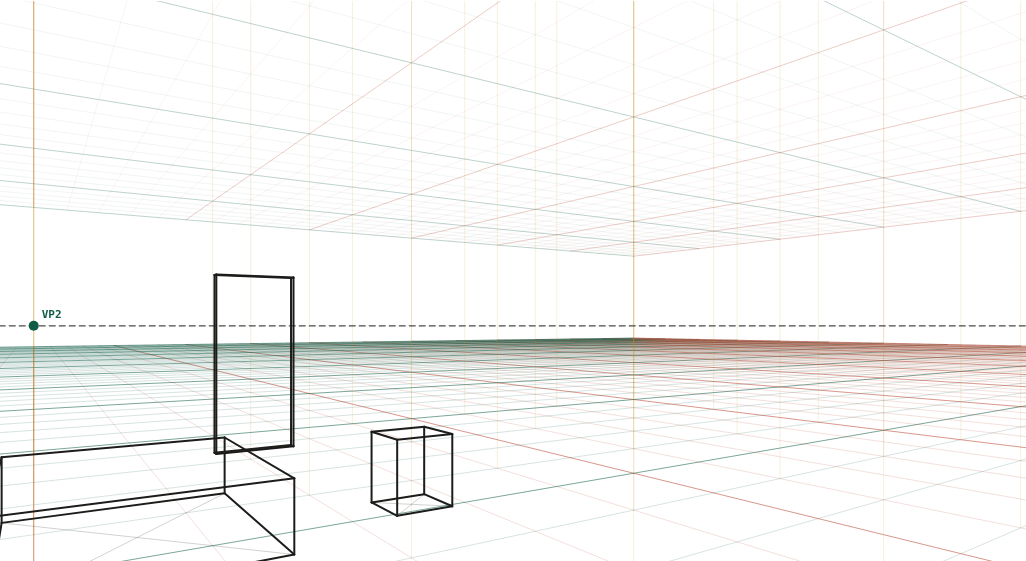
Bed, bedside table, wardrobe and door from the corner of the room at 24 mm.
What to look at
Two vanishing points, both off the picture: the bed's long edges go to one, its short edges to the other.
The wardrobe (2 m) rises above the horizon; the bed (0.5 m) sits well below it, so you see its whole top.
A 24 mm lens is what makes a small room feel roomy; at 50 mm the wardrobe would not fit.
What this scene is for
The scene for a room seen from a corner rather than a doorway, which is how most rooms are photographed and most interiors are illustrated. Bed, bedside table, wardrobe and door give you the three heights a bedroom actually contains, and a 24 mm lens is what makes a 4 m room look like a room instead of a cupboard.
The mistake it settles
Drawing the two vanishing points on the page. At 24 mm and 35° of rotation they fall well outside it, and a drawing with both points visible on an A4 sheet is a drawing seen through a lens no camera sells. If the lines will not reach, use the grid squares and match the angles rather than pulling the points inward.
The camera
| Lens | 24 mm on full frame |
| Camera height | 1.5 m above the floor (standing) |
| Rotation | 35° to the scene's axes |
| Tilt | level (verticals stay vertical) |
| Objects | 1.6 × 2 × 0.5 m block · 0.5 × 0.5 × 0.6 m block · 1.2 × 0.6 × 2 m block · 2.1 m door |
| Floor | 1 m squares |
Measured off this render
Taken from the same camera model the tool draws with, on the 1340 × 754 PNG above.
| Angle of view | 73.7° across (24 mm on full frame) |
| Horizon | 437 px from the top, 58% of the image height |
| Depth-axis vanishing point | 44 px from the left edge |
| Width-axis vanishing point | 606 px beyond the right edge |
| Object | Distance | Height on the render | Below the horizon |
|---|---|---|---|
| 1.6 × 2 × 0.5 m block | 5.5 m | 92 px | all of it |
| 0.5 × 0.5 × 0.6 m block | 5.8 m | 93 px | all of it |
| 1.2 × 0.6 × 2 m block | 7.4 m | 359 px | 75% |
| 2.1 m door | 8.9 m | 226 px | 71% |
Draw it from these numbers
- Rule the horizon across the sheet at 58% of the picture height — 437 px down on this 754 px render. Every other line in the scene is measured from it.
- Two vanishing points on that line: 44 px from the left edge, and 606 px beyond the right edge — close enough to reach on a larger sheet.
- Set the scale from the 1.2 × 0.6 × 2 m block at 7.4 m: 359 px tall, with 75% of it below the horizon. That share is the camera height divided by the object's height (1.5 ÷ 2 m), and it is the same for every object of that height anywhere in the picture.
Open the reference in the tool to move the camera, change the lens, or add your own objects at real sizes; the share link keeps your version. Draw over the PNG at 30–50% opacity in any app with layers.
Question
Why does a wide lens make a small bedroom look larger?
It takes in more of the room from the same standing spot: at 24 mm the camera sees 74° across, at 50 mm only 40°. Nothing about the room changes, so the near end grows and the far wall shrinks. It is also why estate-agent photographs disappoint in person.