Head box from below
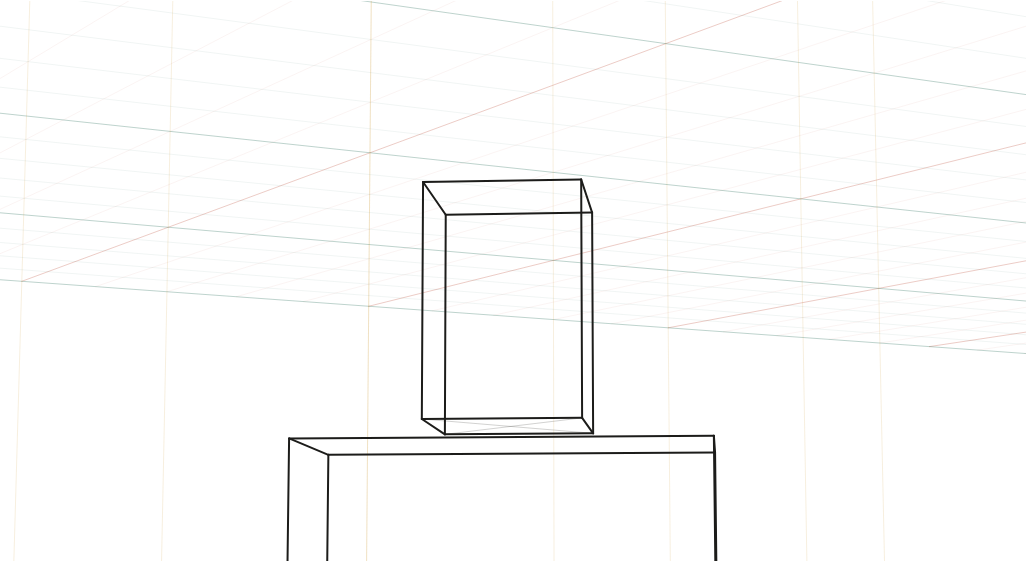
A 16 × 20 × 24 cm head box on a body block at 2.5 m, camera 1.3 m tilted 8° up: the low three-quarter view.
What to look at
The underside of the box is visible: jaw, nostrils and brow ridge in a real head.
Verticals converge upward; the far side of the box is narrower.
Turn the camera to change the three-quarter angle; the box stays the head's proportions.
What this scene is for
The head reduced to a 16 × 20 × 24 cm box on a body block, seen from slightly below on an 85 mm lens — portrait geometry rather than a wide-angle caricature. Use it for character drawing, comic panels and any portrait where the viewer is looking up.
The mistake it settles
Curving the features without turning the box. Every feature of a face sits on a plane of that box: the eye line, the brow, the base of the nose, the mouth. Get the box's tilt and turn right and the features follow; draw the features first and the head will fight you.
The camera
| Lens | 85 mm on full frame |
| Camera height | 1.3 m above the floor (seated) |
| Rotation | 30° to the scene's axes |
| Tilt | 8° up (three vanishing points) |
| Objects | 0.42 × 0.24 × 1.48 m block · 0.16 × 0.2 × 0.24 m block |
| Floor | 1 m squares |
Measured off this render
Taken from the same camera model the tool draws with, on the 1340 × 754 PNG above.
| Angle of view | 23.9° across (85 mm on full frame) |
| Horizon | 68 px below the bottom edge — outside the picture |
| Depth-axis vanishing point | 1,175 px beyond the left edge |
| Width-axis vanishing point | 4,864 px beyond the right edge |
| Vertical point | Zenith 22,135 px above the picture |
| Object | Distance | Height on the render | Below the horizon |
|---|---|---|---|
| 0.42 × 0.24 × 1.48 m block | 2.5 m | 2,036 px | 89% |
| 0.16 × 0.2 × 0.24 m block | 2.5 m | 298 px | none of it |
Draw it from these numbers
- The horizon is off the bottom of the picture, 68 px below the edge, which is what makes everything loom.
- Two vanishing points on that line: 1,175 px beyond the left edge, and 4,864 px beyond the right edge — far enough out that you should match the grid angles instead of chasing it.
- Nothing here is truly vertical: the uprights lean to a zenith 22,135 px above the picture, so the lean is slight but it is there.
- Set the scale from the 0.42 × 0.24 × 1.48 m block at 2.5 m: 2,036 px tall, with 89% of it below the horizon. That share is the camera height divided by the object's height (1.3 ÷ 1.48 m), and it is the same for every object of that height anywhere in the picture.
Open the reference in the tool to move the camera, change the lens, or add your own objects at real sizes; the share link keeps your version. Draw over the PNG at 30–50% opacity in any app with layers.
Question
Why use a box for a head instead of a ball?
A ball has no orientation. The box carries the tilt, the turn and the three planes the face is built on, which is what tells you whether you should be seeing the underside of the jaw or the top of the skull. The ball comes back later, for the cranium.