Head box from above
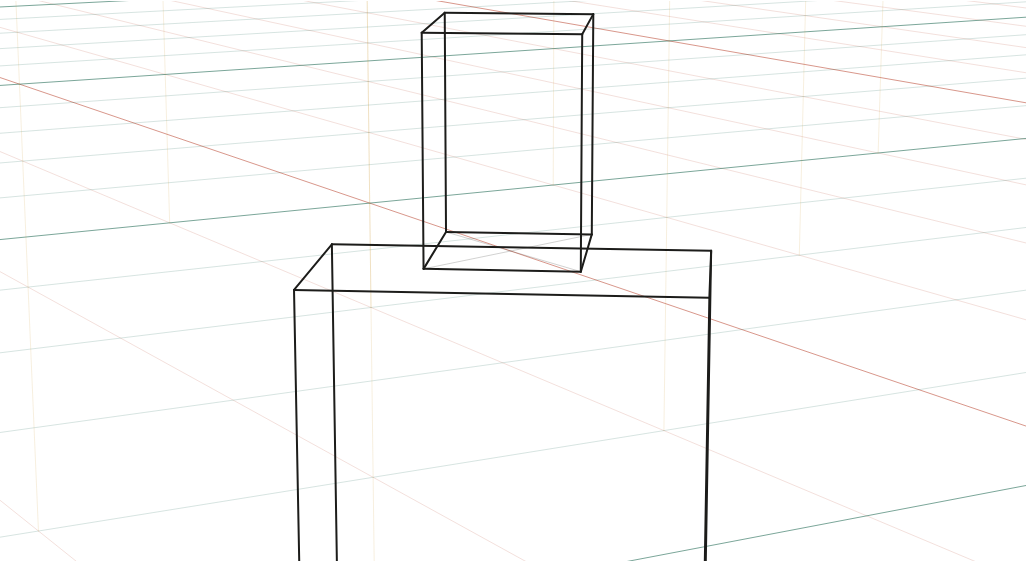
The same head box and body block from a camera at 2 m tilted 12° down: the high three-quarter view.
What to look at
The top of the box is visible: the crown of the skull and the top plane of the nose.
Verticals converge downward toward the chin.
The eye line, a third of the way down the front face, curves with the box's top edge in a real head.
What this scene is for
The same head box from 2 m up, tilted 12° down: the view of anyone shorter than you, or a character looking down. Pair it with the from-below reference to see how far the features travel for a small change of camera height.
The mistake it settles
Keeping the eye line halfway down the head. Seen from above, the eye line curves with the top edge of the box and sits lower on the face than the usual halfway rule suggests; seen from below it curves the other way. The rule is for a level view only.
The camera
| Lens | 85 mm on full frame |
| Camera height | 2 m above the floor (standing) |
| Rotation | 30° to the scene's axes |
| Tilt | 12° down (three vanishing points) |
| Objects | 0.42 × 0.24 × 1.48 m block · 0.16 × 0.2 × 0.24 m block |
| Floor | 1 m squares |
Measured off this render
Taken from the same camera model the tool draws with, on the 1340 × 754 PNG above.
| Angle of view | 23.9° across (85 mm on full frame) |
| Horizon | 296 px above the top edge — outside the picture |
| Depth-axis vanishing point | 1,197 px beyond the left edge |
| Width-axis vanishing point | 4,932 px beyond the right edge |
| Vertical point | Nadir 14,508 px below the picture |
| Object | Distance | Height on the render | Below the horizon |
|---|---|---|---|
| 0.42 × 0.24 × 1.48 m block | 2.5 m | 1,600 px | all of it |
| 0.16 × 0.2 × 0.24 m block | 2.5 m | 297 px | all of it |
Draw it from these numbers
- The horizon is off the top of the picture, 296 px above the edge. Mark it on a larger sheet, or work from the grid: it is why every roof and every head is below you.
- Two vanishing points on that line: 1,197 px beyond the left edge, and 4,932 px beyond the right edge — far enough out that you should match the grid angles instead of chasing it.
- Nothing here is truly vertical: the uprights lean to a nadir 14,508 px below the picture, so the lean is slight but it is there.
- Set the scale from the 0.42 × 0.24 × 1.48 m block at 2.5 m, 1,600 px tall on the render; the horizon passes above it, so it is shorter than the 2 m camera.
Open the reference in the tool to move the camera, change the lens, or add your own objects at real sizes; the share link keeps your version. Draw over the PNG at 30–50% opacity in any app with layers.
Question
How much does the eye line move when the camera rises?
In this pair, moving the camera from 1.3 m to 2 m and tilting 12° down moves it a noticeable fraction of the head's height and reverses the curve of every horizontal feature. That is why portrait photographers argue about camera height at all.