Cylinders at three heights
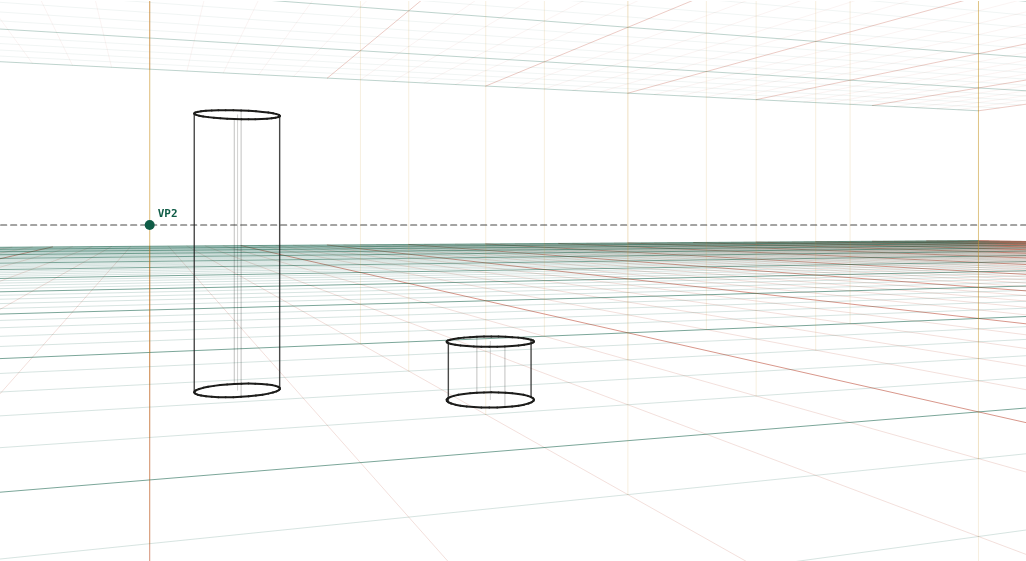
Three 0.6 m cylinders 0.4, 1 and 2 m tall from a camera at 1.2 m: ellipse degree by height.
What to look at
The rim nearest eye level is the thinnest ellipse; bases far below it are the roundest.
The tall cylinder's top is above eye level, so you see its underside curve the other way.
Every ellipse's minor axis points at the cylinder's axis, not at the horizon.
What this scene is for
Three 0.6 m cylinders at 0.4, 1 and 2 m tall from a camera at 1.2 m: the reference for ellipse degree. Use it for cups, cans, tins, columns, tree trunks, wheels and every other round thing that has to sit in a drawing.
The mistake it settles
Drawing every ellipse the same. An ellipse opens as it gets further from eye level: the rim nearest the horizon is nearly a line, the base of the short cylinder is wide open, and the top of the tall one — above eye level — curves the other way entirely.
The camera
| Lens | 35 mm on full frame |
| Camera height | 1.2 m above the floor (seated) |
| Rotation | 20° to the scene's axes |
| Tilt | level (verticals stay vertical) |
| Objects | 1 m cylinder · 2 m cylinder · 0.4 m cylinder |
| Floor | 1 m squares |
Measured off this render
Taken from the same camera model the tool draws with, on the 1340 × 754 PNG above.
| Angle of view | 54.4° across (35 mm on full frame) |
| Horizon | 302 px from the top, 40% of the image height |
| Depth-axis vanishing point | 196 px from the left edge |
| Width-axis vanishing point | 2,909 px beyond the right edge |
| Object | Distance | Height on the render | Below the horizon |
|---|---|---|---|
| 1 m cylinder | 6.2 m | 253 px | all of it |
| 0.4 m cylinder | 6.9 m | 76 px | all of it |
| 2 m cylinder | 7.5 m | 359 px | 60% |
Draw it from these numbers
- Rule the horizon across the sheet at 40% of the picture height — 302 px down on this 754 px render. Every other line in the scene is measured from it.
- Two vanishing points on that line: 196 px from the left edge, and 2,909 px beyond the right edge — far enough out that you should match the grid angles instead of chasing it.
- Set the scale from the 2 m cylinder at 7.5 m: 359 px tall, with 60% of it below the horizon. That share is the camera height divided by the object's height (1.2 ÷ 2 m), and it is the same for every object of that height anywhere in the picture.
Open the reference in the tool to move the camera, change the lens, or add your own objects at real sizes; the share link keeps your version. Draw over the PNG at 30–50% opacity in any app with layers.
Question
How do I know how open an ellipse should be?
By how far its circle is from eye level, measured against how far away it is. On this reference the 2 m cylinder's top sits above the 1.2 m horizon and shows its underside; the 0.4 m one's top is well below and shows a fat ellipse. The ellipse guide lesson turns that into a degree number.