 by
by A circle in perspective is an ellipse, and everyone knows it; the trouble is that an ellipse has a size, a degree and a direction, and a drawing goes wrong when any of the three is off. Of the three things an ellipse in perspective has to get right, the degree is the one people guess at, and it is also the one a viewer notices immediately when it is wrong. The direction of tip comes second. The centre is the one that quietly ruins wheels. All three have rules, and none of them need measuring. Then cylinders, which are two ellipses and two lines, and wheels, which are the case that catches most people.
Ellipse in perspective is the shape a circle makes when seen from an angle. It has a major axis (its long diameter) and a minor axis (its short one, at right angles to the major). Its degree is how round it is, from 0° (a straight line, seen edge-on) to 90° (a full circle, seen square-on), and it is named for the angle between the line of sight and the circle's plane. In a drawing, the minor axis always lies along the axis of the cylinder or hole the circle belongs to.
The degree rule: distance from eye level
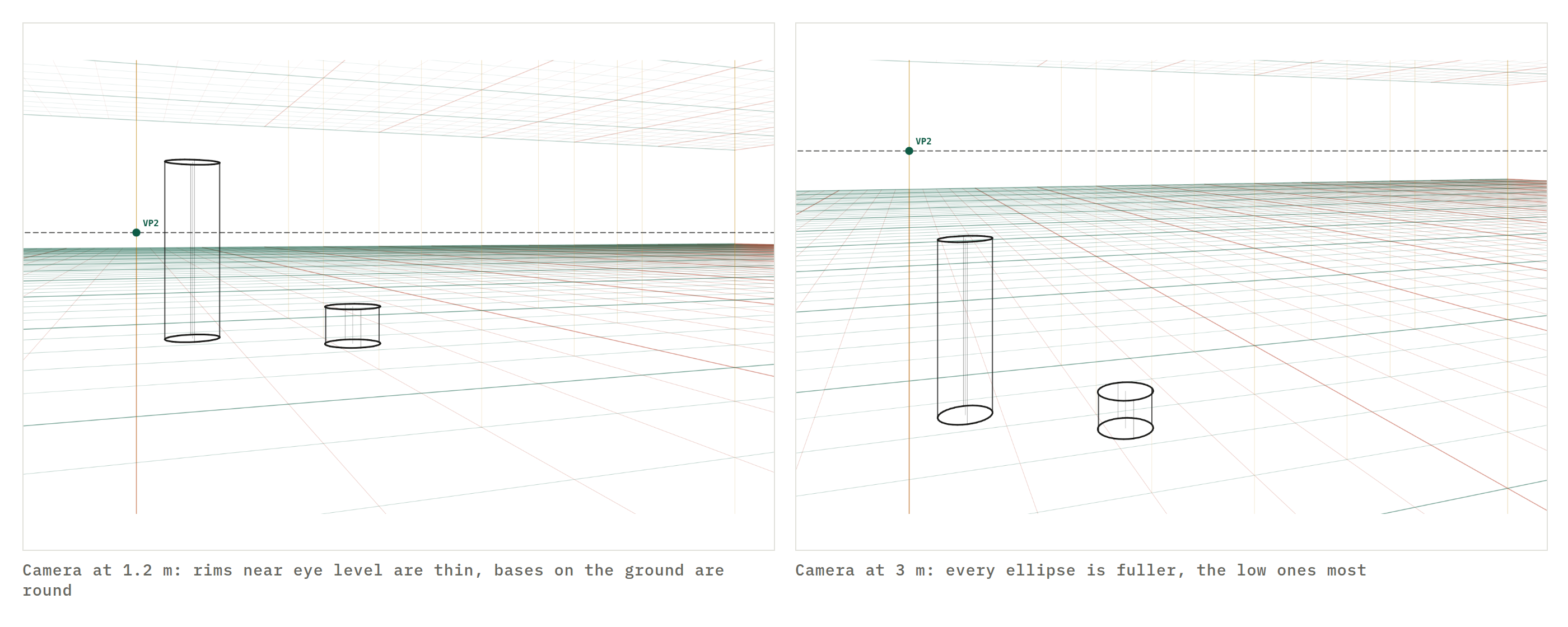
Take a horizontal circle, a cup's rim. If the rim is exactly at your eye level you see it as a straight line. Lower the cup and the rim opens into a thin ellipse; lower it further and the ellipse gets rounder; put it on the floor and it is quite fat. Raise it above your eye level and the same happens in the other direction, with the ellipse opening the other way. The rule: the degree of a horizontal ellipse grows with its distance from the horizon. Every horizontal ellipse in a picture obeys it, which gives you an instant check: two rims at the same height in the same picture must have the same degree; a rim lower in the picture must be rounder than one higher up (below the horizon).
Vertical circles, a wheel or a clock on a wall, obey the same rule sideways: the degree grows with distance from the vanishing point of the circle's axis. A wheel whose axle points straight at you is a circle; a wheel far to the side of that direction is a thin ellipse.
For a cylinder standing on a table below eye level, this means the bottom ellipse is always rounder than the top. Draw them the same and the cylinder looks like a paper tube seen through a lens with no perspective. The perspective box generator draws cylinders with correct ellipses at any height and camera; change the camera height and watch the degrees change.
The axis rule: the minor axis follows the cylinder
The second rule sets the tilt. The minor axis of the ellipse lies along the axis of the cylinder. For a can standing upright the cylinder's axis is vertical, so the minor axis is vertical and the ellipse sits level: its major axis is horizontal, regardless of where the can is in the picture. This surprises people who expect the rim to tilt toward the vanishing point. It does not; the enclosing square tilts, but the ellipse inside it is level.
For a cylinder lying down (a pipe, a rolling pin, an axle) the axis runs to a vanishing point, and so does the minor axis of every ellipse along it. The ellipses tip: their major axes are at right angles to the line running to the vanishing point, not vertical. Wheels are this case; see below.
Drawn the wrong way, the tilt is what makes a cylinder look bent or a wheel look like it is falling off. Draw the axis line first, every time, and hang the ellipses on it with their minor axes along it.
The centre rule: the true centre is behind the middle
An ellipse is symmetrical about both its axes, but the circle it represents is not seen symmetrically: the near half is closer and appears larger. So the true centre of the circle (where a spoke would be fixed, where a straw stands in a glass) is not at the geometric centre of the ellipse but a little toward the far side. Find it properly by drawing the circle's enclosing square in perspective and crossing its diagonals: the crossing is the true centre, and the ellipse touches the square at the midpoints of its four sides, which are themselves found by lines from the diagonal crossing to the vanishing points.
The offset is small for distant or small circles and can be ignored for a coin across the room. It matters for a near wheel, a bowl seen from above, a clock face at arm's length, a table top: the middle of a round table is behind the middle of its ellipse, which is where the vase goes.
How to draw an ellipse, on its own
Before it goes into perspective, an ellipse is a shape with two axes at right angles, and the way to draw one freehand is the same at any degree. Mark the two ends of the major axis and the two ends of the minor axis; the ellipse passes through all four and is widest at the major, narrowest at the minor. Then draw it in one continuous motion from the shoulder, not the wrist, going round two or three times lightly before committing, and keep the curve moving at the ends: the commonest fault is a pointed end, like a lemon, where the curve should be roundest at the tips of the major axis and flattest along the sides. The two halves on either side of each axis are mirror images, so check by folding the page in your head. A template takes the wrist out of it, which is why draughtsmen use them.
The degree of a freehand ellipse is just the ratio of the minor axis to the major: a 30° ellipse is half as tall as it is wide (sin 30° = 0.5), a 45° one is 0.71, a 60° one is 0.87. Decide the degree, set the minor axis to that fraction of the major, and draw.
Constructing an ellipse in a square
When the ellipse has to be right (a wheel, a tower, a dome), construct it:
- Draw the square the circle fits in, in perspective, on the plane the circle lies in: the ground for a horizontal circle, a wall for a vertical one. Its edges go to the vanishing points.
- Cross the diagonals to find the true centre. From the centre, draw lines to the vanishing points to divide the square into quarters; where they meet the sides are the four points where the circle touches the square.
- The circle also passes through the diagonals at about 0.71 of the way from the centre to each corner (√2/2). Mark those four points by eye or by measuring the near diagonal and transferring.
- Draw a smooth curve through the eight points, keeping the minor axis along the cylinder's axis and the curve symmetrical about it.
For freehand work an ellipse template or a practised wrist is faster, and the construction is the check: draw the square, drop the ellipse in with a template at the degree the square suggests, and look for the touching points.
Cylinders
A cylinder is two ellipses on one axis, joined by two straight lines tangent to both. The steps:
Draw the axis line: vertical for a standing cylinder, a line to a vanishing point for a lying one. Mark the two ends. At each end draw an ellipse with its minor axis on the axis line, the far one thinner if the cylinder is nearer the eye level at that end. Join them with the two tangent lines. For a standing cylinder the tangents are vertical (or converge to the third vanishing point in a tilted view); for a lying one they run to the same vanishing point as the axis.
Cones, bottles, cups and wheels are cylinders with a change of radius, and the same construction with a different ellipse size at each station along the axis. A bottle is a stack of ellipses of different widths all on one vertical axis, all level, the lower ones fatter than the upper.
Wheels
A car's wheels defeat more drawings than anything else in this lesson, and the reason is the axis rule. The axle is a horizontal cylinder running across the car, so it goes to a vanishing point; each wheel is a circle on that axle, so each wheel's minor axis lies along the axle line, tipped, not vertical. The wheel on the near side is a higher degree than the wheel on the far side, because the near one is further from the axle's vanishing point. And since the car's axles are parallel, all four wheels have minor axes aiming at the same vanishing point.
Draw a car's wheels by drawing the two axles as lines to the vanishing point first, marking where each wheel sits on them, then drawing each ellipse with its minor axis on the line. Give each wheel thickness with a second ellipse a little further along the axle toward the vanishing point, and connect the two with short tangent lines. The tyre's tread sits between them. The how to draw a car in perspective lesson builds the whole vehicle this way.
Where ellipses go wrong
Pointy ends. An ellipse is round everywhere; there are no corners at the ends of the major axis. Draw it as one continuous curve, or rotate the paper and draw it in two strokes that overlap.
Tilted rims on upright cylinders. The rim of a standing can is level. If it tips, the can is falling over.
Same degree top and bottom. A cylinder below eye level is rounder at the bottom. Two identical ellipses read as no perspective.
Vertical wheels. Wheels seen from a three-quarter view have tipped minor axes along the axle. Vertical minor axes belong only to a car seen exactly from the side.
Objects centred in the ellipse. The vase, the straw, the hub go at the true centre, toward the far side, not at the middle of the ellipse.
Try it
Set the box generator camera to 1.2 m and add three cylinders of different heights. Draw them; then move the camera to 0.5 m and draw them again, watching the degrees change. Then draw a car body as a box, put two axle lines to the vanishing point through it, and hang four wheels on them.
Keep going
How to draw a car in perspective · how to draw perspective · figures in perspective · perspective box generator
Questions
Why does a circle become an ellipse in perspective?
Because a circle is a flat shape and you are looking at it from an angle. Seen edge-on it is a line; seen square-on it is a circle; in between it is an ellipse, and the further the circle is from your eye level (for a horizontal circle) or from the centre of your view (for a vertical one), the rounder the ellipse.
What is the degree of an ellipse?
The angle between your line of sight and the plane of the circle, which is also the name on an ellipse template: a 10° ellipse is nearly a line, a 60° ellipse is nearly round. A horizontal circle at eye level is 0°; the further below or above eye level it sits, the higher its degree.
Which way does the minor axis of the ellipse point?
Along the axis of the cylinder, in the drawing. For a horizontal circle (a cup on a table) the cylinder's axis is vertical, so the minor axis is vertical. For a wheel, the minor axis lies along the axle, which is a line to that direction's vanishing point, not along the horizon.
Why is the centre of the circle not the centre of the ellipse?
The near half of the circle is closer to you and looks bigger than the far half, so the true centre (where the diagonals of the circle's enclosing square cross in perspective) sits behind the ellipse's geometric centre, toward the far side. The difference is small for far circles and large for near ones.
How do I draw the ellipse at the bottom of a cylinder?
Rounder than the one at the top, if the cylinder is below eye level: the bottom is further from your eye level, so its ellipse has a higher degree. Draw both ellipses with the same minor-axis direction, the bottom one fuller, and join them with the two sides tangent to both.
How do I draw wheels in perspective?
Draw the axle first as a line to its vanishing point. Each wheel is an ellipse whose minor axis lies along that line, with the near wheel a higher degree than the far one. Then give the wheel thickness with a second, slightly offset ellipse toward the vanishing point.
A new lesson and a new grid, about once a month.
Each lesson arrives by email before it goes on the site, with the grid it was drawn on and the link to open it. Subscribers also get both free starter packs and the subscriber price on the paid ones. Never more than two emails a month; one click to leave.
Handled by Kit on our behalf. Your address is used for this letter and nothing else — see the privacy page.