Narrow alley at 20 mm
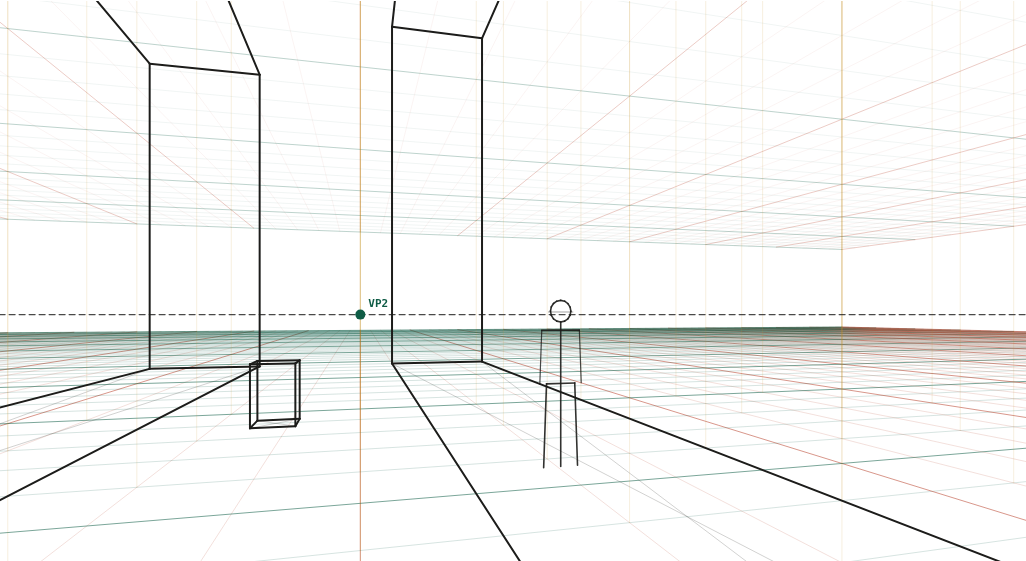
A 4 m alley between two tall walls at 20 mm with a figure and a bin, camera turned 15°.
What to look at
Near the edges the walls splay: this is the cone of vision being exceeded, honest but dramatic.
The near vanishing point is close to the centre because the camera is only turned 15°.
The figure at 6 m is small against the walls; the bin at 9 m smaller still.
What this scene is for
A 4 m alley between tall walls at 20 mm, turned only 15°. Use it for claustrophobic exteriors, night scenes, chase panels, and as a demonstration of what happens when a wide lens is pointed down a narrow space.
The mistake it settles
Correcting the splay at the edges. The stretched walls near the frame edge are what a 20 mm lens genuinely does — the cone of vision has been exceeded and the drawing is honest about it. Straighten them and you have a 35 mm drawing with a 20 mm sense of depth, which reads as wrong without anyone being able to say why.
The camera
| Lens | 20 mm on full frame |
| Camera height | 1.6 m above the floor (standing) |
| Rotation | 15° to the scene's axes |
| Tilt | level (verticals stay vertical) |
| Objects | 3 × 30 × 9 m block · 3 × 30 × 11 m block · 1.75 m figure · 0.6 × 0.6 × 0.9 m block |
| Floor | 1 m squares |
Measured off this render
Taken from the same camera model the tool draws with, on the 1340 × 754 PNG above.
| Angle of view | 84° across (20 mm on full frame) |
| Horizon | 422 px from the top, 56% of the image height |
| Depth-axis vanishing point | 471 px from the left edge |
| Width-axis vanishing point | 2,108 px beyond the right edge |
| Object | Distance | Height on the render | Below the horizon |
|---|---|---|---|
| 3 × 30 × 11 m block | 4.7 m | 1,815 px | 15% |
| 3 × 30 × 9 m block | 6 m | 2,482 px | 18% |
| 1.75 m figure | 6 m | 217 px | 91% |
| 0.6 × 0.6 × 0.9 m block | 9.1 m | 80 px | all of it |
Draw it from these numbers
- Rule the horizon across the sheet at 56% of the picture height — 422 px down on this 754 px render. Every other line in the scene is measured from it.
- Two vanishing points on that line: 471 px from the left edge, and 2,108 px beyond the right edge — far enough out that you should match the grid angles instead of chasing it.
- Set the scale from the 3 × 30 × 11 m block at 4.7 m: 1,815 px tall, with 15% of it below the horizon. That share is the camera height divided by the object's height (1.6 ÷ 11 m), and it is the same for every object of that height anywhere in the picture.
Open the reference in the tool to move the camera, change the lens, or add your own objects at real sizes; the share link keeps your version. Draw over the PNG at 30–50% opacity in any app with layers.
Question
What is the cone of vision, and does breaking it matter?
It is the roughly 60° cone in which the eye sees without noticeable distortion; wider than that, objects near the edge stretch. Breaking it is not an error — photographers do it every day — but it should be a decision. Keep faces and key objects inside the middle two-thirds and the stretch reads as drama rather than a slip.