Avenue, one-point
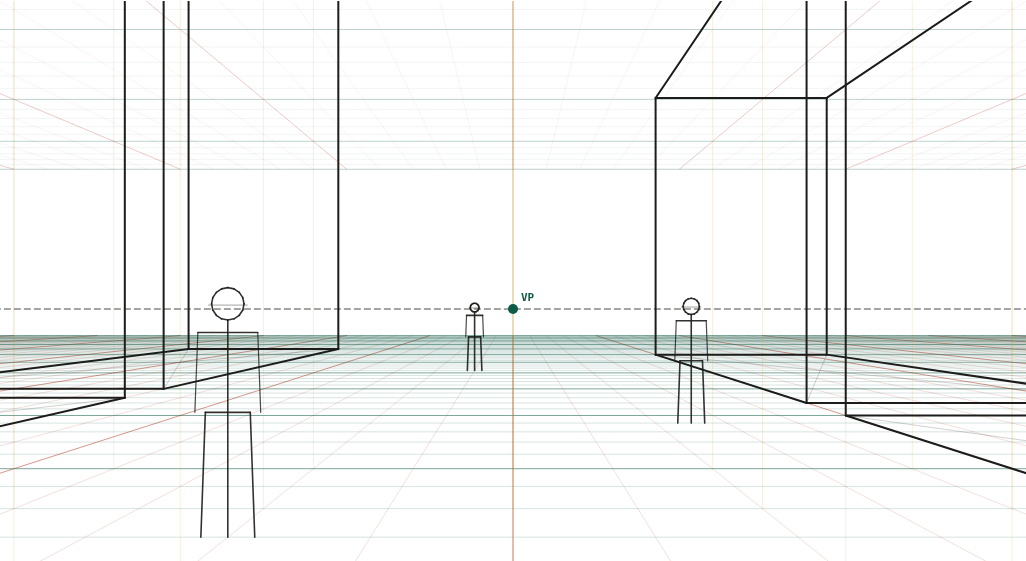
Buildings both sides of a wide avenue seen down the middle at 35 mm, with figures at 7, 14 and 26 m.
What to look at
Everything converges to one point on the horizon at the end of the street.
Facades parallel to the picture plane keep their true shape and only shrink.
The three figures shrink in exact proportion to distance: 14 m is half the size of 7 m.
What this scene is for
The straight-down-the-middle avenue: buildings both sides, figures at 7, 14 and 26 m, everything converging on one point. Use it for city streets seen from the centre line, boulevards, railway tracks, and the classic depth shot where the road runs to the horizon.
The mistake it settles
Shrinking the figures by eye. Distance and size are exactly inverse: the figure at 14 m is half the height of the one at 7 m, and the one at 26 m is just over a quarter. Guessing produces figures that all look mid-distance, which flattens the street you spent an hour drawing.
The camera
| Lens | 35 mm on full frame |
| Camera height | 1.6 m above the floor (standing) |
| Rotation | square to the scene (one-point) |
| Tilt | level (verticals stay vertical) |
| Objects | 6 × 16 × 10 m block · 6 × 20 × 14 m block · 6 × 14 × 12 m block · 6 × 18 × 9 m block · 3 × 1.75 m figure |
| Floor | 1 m squares |
Measured off this render
Taken from the same camera model the tool draws with, on the 1340 × 754 PNG above.
| Angle of view | 54.4° across (35 mm on full frame) |
| Horizon | 415 px from the top, 55% of the image height |
| Depth-axis vanishing point | 670 px from the left edge |
| Object | Distance | Height on the render | Below the horizon |
|---|---|---|---|
| 1.75 m figure | 7.3 m | 326 px | 91% |
| 6 × 14 × 12 m block | 11.3 m | 1,954 px | 13% |
| 6 × 16 × 10 m block | 14.1 m | 1,303 px | 16% |
| 1.75 m figure | 14.2 m | 163 px | 91% |
| 1.75 m figure | 26 m | 88 px | 91% |
Draw it from these numbers
- Rule the horizon across the sheet at 55% of the picture height — 415 px down on this 754 px render. Every other line in the scene is measured from it.
- One vanishing point, 670 px from the left edge (50% across). Every depth edge runs to it; the faces square to you keep their shape.
- Set the scale from the 1.75 m figure at 7.3 m: 326 px tall, with 91% of it below the horizon. That share is the camera height divided by the object's height (1.6 ÷ 1.75 m), and it is the same for every object of that height anywhere in the picture.
Open the reference in the tool to move the camera, change the lens, or add your own objects at real sizes; the share link keeps your version. Draw over the PNG at 30–50% opacity in any app with layers.
Question
Do the building fronts change shape in a one-point view?
No. Any face parallel to the picture plane keeps its true proportions and only shrinks with distance, which is why one-point streets are quicker to draw than two-point ones. Only the faces running away from you converge.