 by
by Perspective has a vocabulary that sounds like geometry class, and most of it is easier to understand as parts of a camera. This page defines every term you will meet in a perspective lesson, a software manual or an art-school handout, and says what each one does on the grids here, so the words and the sliders line up. Read it once through, then use the headings as a reference.
Linear perspective is the method of drawing a three-dimensional scene on a flat surface so that it looks the way a camera or an eye at one fixed position would see it. Parallel lines converge to vanishing points, equal sizes shrink with distance, and everything is measured against a horizon at the viewer's eye height. It is one fixed viewpoint, one moment; move the eye and the whole drawing changes.
The setup: eye, window, ground
Eye, viewpoint, camera. Perspective describes what one eye sees from one place. Every other term follows from where that eye is: how high above the ground, which way it points, how wide it sees. On the tools that is the camera height slider, the rotation and tilt you get by dragging, and the lens.
Picture plane. The transparent window between the eye and the scene on which the drawing is made. Imagine tracing a street on a pane of glass held up in front of you; the glass is the picture plane and the tracing is the perspective drawing. Anything that touches the glass is drawn at true size. The plane is normally vertical, which keeps vertical edges vertical; tilt it, by looking up or down, and the verticals converge, which is the whole of the difference between two-point and three-point perspective.
Ground plane. The flat floor the scene stands on, the reference for everything at "ground level". The grids draw it as one-metre squares so that distances can be read off it.
Ground line. The line where the picture plane meets the ground plane, the bottom edge of the window. It is the only place on the ground where the drawing is at true scale, which is why traditional constructions start by marking real measurements along it. On screen it is usually below the bottom of the picture; the grid's nearest squares stand in for it.
Station point. The viewer's position seen from above, in a plan drawing. Its distance from the picture plane is what sets the lens: a station point close to the window sees a wide angle through it, a distant one a narrow angle. The tools do not draw it, but the focal length readout is the same fact in millimetres.
Line of sight, centre of vision. The direction the eye points, and the spot on the picture plane straight in front of it. In one-point perspective the centre of vision is the vanishing point; in every case it is the centre of the least distorted part of the picture. Dragging a grid changes the line of sight; the centre of vision stays in the middle of the canvas.
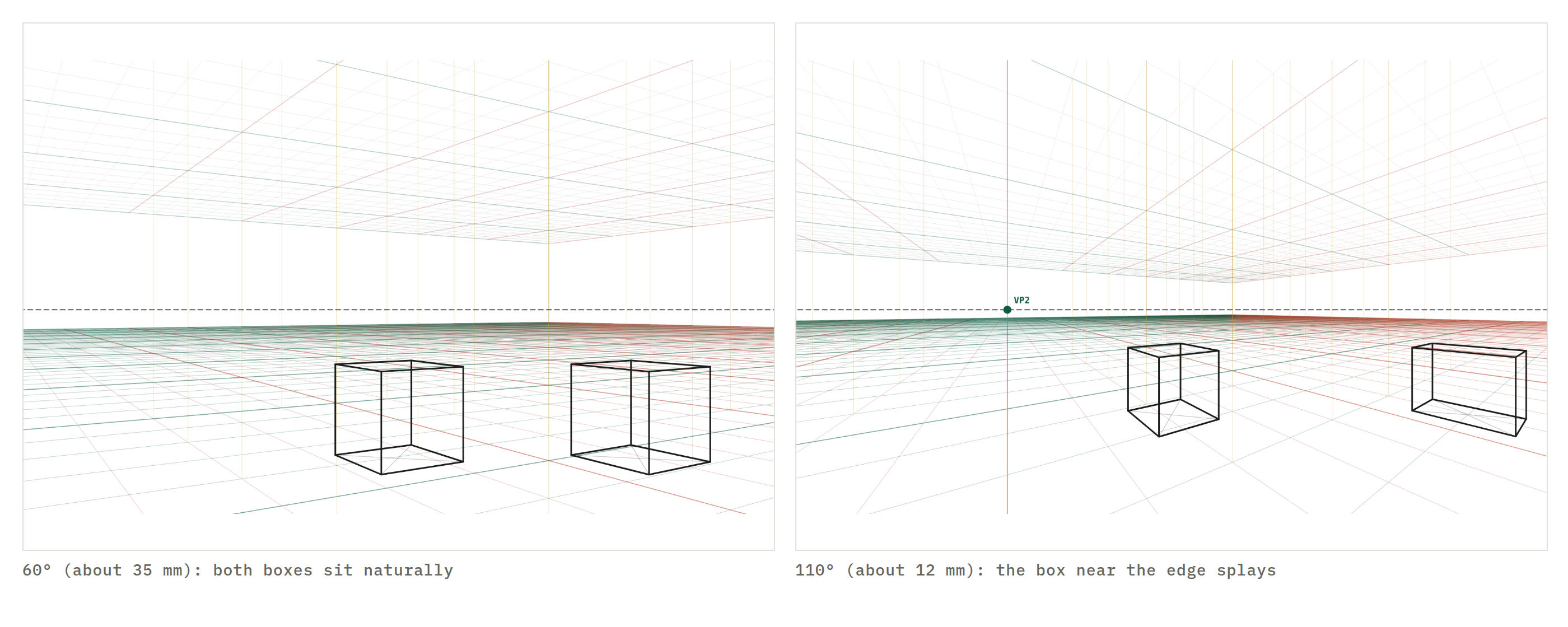
Cone of vision. The angle around the line of sight within which things look natural, conventionally 60° across, at most 90°. Perspective keeps working outside it, but objects near the edge stretch, because a flat picture plane has to make the sides of the view bigger to keep straight lines straight. A 60° cone is roughly a 35 mm lens; a 90° cone is about 20 mm. If you need more than 90°, the honest answer is a curvilinear grid, which bends the lines instead of stretching the edges.
Field of view, lens, focal length. The same fact from the camera side: how wide an angle the picture covers. A long lens (85 mm, 24°) sees a narrow slice and flattens depth; a wide lens (24 mm, 74°) sees a broad angle and exaggerates it. On every grid here the lens is a slider with the angle and the millimetres shown together, and the lens to field of view calculator converts one to the other.
The lines
Horizon line, eye level. Two names for one line: the height of the eye, drawn across the picture. Every horizontal surface flattens to nothing at it, so the tops of tables below eye level are visible and the tops of shelves above it are not. Every vanishing point of every horizontal line sits on it. It is not where sky meets sea; that edge happens to be at eye level only because the sea is flat. Move the horizon on any grid and you are moving the camera up or down: high for a balcony, low for a child or a cat. The horizon height calculator gives the height from a known object.
Perspective lines. The loose, everyday term for all of the construction lines together: the horizon, the lines running to each vanishing point, and the grid of squares on the ground. When someone asks for "perspective lines" over a photo or a blank canvas they mean the fan of orthogonals from each vanishing point, which is exactly what a perspective grid exports; the vanishing point finder draws them over a photograph from its own converging edges.
Orthogonals, converging lines, receding lines. Lines in the scene that go away from the viewer, which is to say lines that are not parallel to the picture plane. In the drawing they converge to a vanishing point. In one-point perspective they are the lines going to the single central point; in two-point there are two families.
Transversals. Lines parallel to the picture plane. They do not converge; they stay horizontal (or vertical), only getting closer together with distance. The front edge of a table seen straight on is a transversal; its side edges are orthogonals.
Verticals. Vertical lines stay vertical as long as the picture plane is vertical, which is the case whenever the camera is level. Tilt the camera and they converge to a point above or below: three-point perspective.
Diagonals. Lines at 45° to the picture plane, which have their own vanishing point on the horizon at the same distance from the centre of vision as the station point is from the picture plane. That coincidence is why diagonals are used for measuring depth in traditional construction: the distance point, below.
The points
Vanishing point (VP). Where a family of parallel lines meets in the picture. Every direction in the scene has one; the "one", "two" and "three" of one-, two- and three-point perspective count only the vanishing points of the box you are drawing, not of the whole picture. A tilted roof, an open door and a staircase each add their own. On a two-point grid the VP dots can be dragged apart or together by changing the lens: close together for wide lenses, far apart for long ones, which is what makes a wide-angle drawing feel splayed.
Left and right vanishing points (VP1, VP2). The two horizon points of a box seen from its corner. Turning the box (or the camera) slides them along the horizon in opposite directions: at 45° they are equally far from the centre, at 30°/60° one is close and one is far. Their separation depends on the lens; their position on the horizon depends on the rotation. On the grids, drag sideways to rotate and watch both move.
Zenith and nadir. The vanishing points of vertical lines, above the picture when looking up and below it when looking down. They appear as soon as the camera tilts, and they are what a three-point grid adds to a two-point one. On a curvilinear grid both are present at once, on the rim of the disc.
Diagonal vanishing point, distance point. The vanishing point of 45° diagonals, on the horizon. Used to find how far apart the transversals of equal depths should be: draw a diagonal through the corner of one square and where it crosses the next orthogonal marks the next square. The grids do this for you; it is how the one-metre squares are spaced.
Measuring points. In two-point perspective, points on the horizon used to transfer true measurements from the ground line onto a receding line. Each vanishing point has its own measuring point, found by swinging the station-point distance onto the horizon. The vanishing point distance calculator gives the numbers, and the box generator places boxes at real metres so the construction is rarely needed by hand.
The effects
Convergence. Parallel lines appearing to meet. The most visible effect of perspective and the one grids draw explicitly.
Diminution. Equal sizes getting smaller with distance, in proportion to that distance: twice as far away is half the height. The scale figures on the figures lesson are the practical version; the figure height calculator is the arithmetic.
Foreshortening. A length pointing toward the viewer appearing shorter than its true length. It applies to every receding edge, but the word is used most for figures: an arm pointing at the camera becomes a hand with a short stub behind it. The ground squares of a grid are foreshortened depth made visible; each metre of floor is a thinner strip than the one before.
Overlap. A nearer object hiding part of a farther one. It needs no construction and it is the strongest depth cue of all; a drawing with correct convergence and no overlaps still looks flat.
Atmospheric (aerial) perspective. Distant things becoming paler, bluer and lower in contrast because of the air between. Not a construction at all, but part of the same job of making depth read; it belongs in any list because beginners are often told to "add perspective" when what is missing is atmosphere.
Distortion. Not a separate effect but what convergence and diminution look like when the cone of vision is exceeded: the near end of a car looming, a face's nose enlarged by a phone lens held close. The car lesson has the lens-by-lens comparison.
Kinds of perspective
One-point. One face of the scene parallel to the picture plane; one vanishing point, at the centre of vision. Corridors, roads, rooms seen from the door. Grid.
Two-point. The scene turned so that two sets of horizontal edges recede, to two points on the horizon; verticals stay vertical. Buildings on a corner, furniture, most photographs. Grid.
Three-point. Two-point with the camera tilted, so verticals converge too, to a zenith or a nadir. Towers from the street, streets from a roof. Grid.
Curvilinear (four-, five-, six-point, fisheye). The picture plane replaced by a sphere, so straight lines become arcs and views wider than the cone of vision no longer stretch. Four-point keeps the horizon straight; five-point shows 180°; six-point shows the whole sphere. Curvilinear perspective explained has the theory.
Parallel projection (isometric, dimetric, oblique). Not perspective at all: no vanishing points, equal lengths stay equal at any distance, because the eye is imagined infinitely far away. Used for games, technical drawing and diagrams where measurements matter more than realism. Isometric grid.
The terms on the tools
Every control on the grids here is one of the terms above under another name. Camera height is the horizon. Rotation moves VP1 and VP2 along it. Tilt brings in the zenith or nadir. The lens sets the cone of vision and the distance between vanishing points. The one-metre ground squares are diminution and foreshortening drawn out. Objects in the box generator are real metres placed on that ground, so the measuring-point construction happens for you. When a lesson elsewhere says "find the distance point" or "swing the station point onto the horizon", it is describing by hand what the readouts on the tool already show.
Where these terms are used
How to draw perspective · 1-, 2- and 3-point perspective explained · curvilinear perspective · perspective drawing tools · calculators
Questions
What is the horizon line in perspective?
The line at the height of the viewer's eye. It is where all horizontal planes flatten to nothing and where the vanishing points of every horizontal line sit. It is not the edge of the sea or the land, which only coincide with it when you stand on flat ground; it is your eye level, drawn across the picture.
What is a vanishing point?
The point where a set of parallel lines appears to meet. Every family of parallel lines in the scene has its own vanishing point: horizontal families meet on the horizon, vertical lines meet above (zenith) or below (nadir) when the camera is tilted, and diagonals meet off to the side. A picture has as many vanishing points as there are directions in it, not one, two or three.
What is the picture plane?
The imaginary window between your eye and the scene onto which the drawing is projected. Anything touching it is drawn at true size; everything behind it is smaller. Tilting the picture plane, by tilting the camera, is what turns two-point perspective into three-point.
What is the cone of vision?
The angle you can see without noticeable stretching, usually taken as 60° across. Objects drawn outside it obey the rules but look wrong, splayed like the edges of a wide-angle photograph. On the grids here it corresponds to roughly a 35 mm lens; wider settings put more of the scene outside the cone.
What does foreshortening mean?
The shrinking of a length that points toward you. A metre stick held across the view is a metre long in the drawing; turned to point at you it becomes a short stub, though it is the same stick. Foreshortening is what perspective grids measure: the ground squares show how much a metre of depth shrinks at each distance.
What is the station point?
Where the viewer stands, seen from above in a plan drawing. Its distance from the picture plane fixes the lens: close to the plane is a wide lens, far from it a long lens. On the tools it is the focal-length readout; you never draw it, but every vanishing point depends on it.
A new lesson and a new grid, about once a month.
Each lesson arrives by email before it goes on the site, with the grid it was drawn on and the link to open it. Subscribers also get both free starter packs and the subscriber price on the paid ones. Never more than two emails a month; one click to leave.
Handled by Kit on our behalf. Your address is used for this letter and nothing else — see the privacy page.