Tower from the street
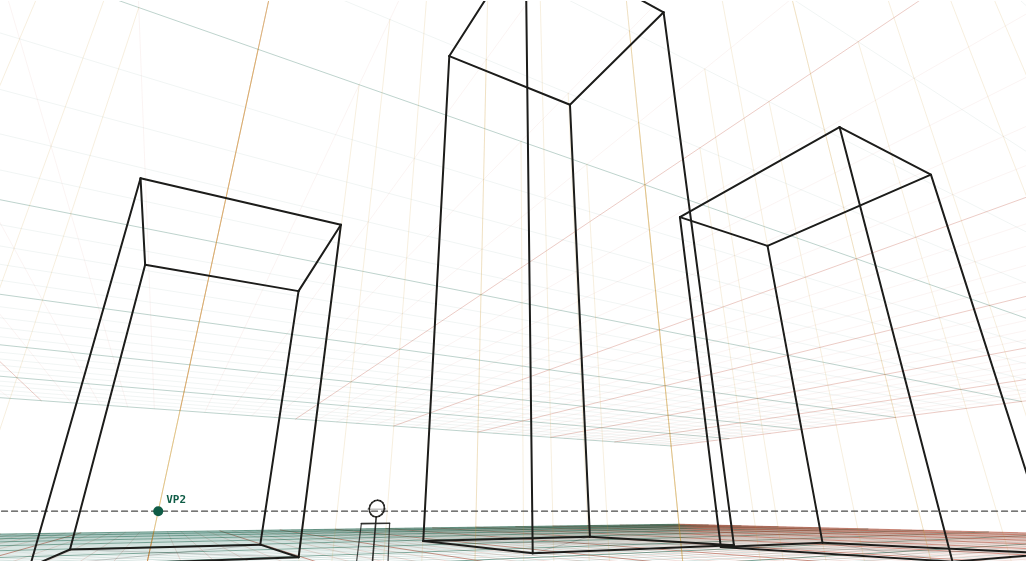
A 36 m tower and two neighbours from the pavement at 20 mm, camera tilted 22° up.
What to look at
Verticals converge upward to a zenith above the picture: three-point perspective looking up.
The horizon has dropped near the bottom of the frame, where the street is.
The wide lens makes the tower lean; at 50 mm the same tilt would look gentler.
What this scene is for
A 36 m tower from the pavement on a 20 mm lens, camera tilted 22° up. The scene for skyscrapers, cathedral interiors, gantries, and any shot where a character stands at the foot of something enormous. Two shorter neighbours are included so you can see how the lean varies with height.
The mistake it settles
Tilting the camera up but drawing the verticals parallel. Once you look up, every vertical converges toward a zenith above the picture — in this render roughly 1,470 px above the top edge. Parallel verticals with a low horizon read as a mistake rather than a choice.
The camera
| Lens | 20 mm on full frame |
| Camera height | 1.6 m above the floor (standing) |
| Rotation | 30° to the scene's axes |
| Tilt | 22° up (three vanishing points) |
| Objects | 12 × 12 × 36 m block · 8 × 10 × 14 m block · 8 × 10 × 18 m block · 1.75 m figure |
| Floor | 1 m squares |
Measured off this render
Taken from the same camera model the tool draws with, on the 1340 × 754 PNG above.
| Angle of view | 84° across (20 mm on full frame) |
| Horizon | 678 px from the top, 90% of the image height |
| Depth-axis vanishing point | 206 px from the left edge |
| Width-axis vanishing point | 721 px beyond the right edge |
| Vertical point | Zenith 1,466 px above the picture |
| Object | Distance | Height on the render | Below the horizon |
|---|---|---|---|
| 1.75 m figure | 9.2 m | 180 px | 92% |
| 8 × 10 × 14 m block | 29.5 m | 401 px | 14% |
| 8 × 10 × 18 m block | 32.3 m | 461 px | 11% |
| 12 × 12 × 36 m block | 34.1 m | 664 px | 6% |
Draw it from these numbers
- Rule the horizon across the sheet at 90% of the picture height — 678 px down on this 754 px render. Every other line in the scene is measured from it.
- Two vanishing points on that line: 206 px from the left edge, and 721 px beyond the right edge — close enough to reach on a larger sheet.
- Nothing here is truly vertical: the uprights lean to a zenith 1,466 px above the picture.
- Set the scale from the 1.75 m figure at 9.2 m: 180 px tall, with 92% of it below the horizon. That share is the camera height divided by the object's height (1.6 ÷ 1.75 m), and it is the same for every object of that height anywhere in the picture.
Open the reference in the tool to move the camera, change the lens, or add your own objects at real sizes; the share link keeps your version. Draw over the PNG at 30–50% opacity in any app with layers.
Question
Why does a wide lens make a building lean more?
It does not change the geometry, it changes how much of it you see. A 20 mm lens takes in 84° across, so the zenith sits close enough to the frame for the convergence to be steep and obvious. At 50 mm the same camera angle gives a far gentler lean, which is why architectural photographers avoid wide lenses when they want straight walls.