Figures at 5, 10, 20 and 40 m
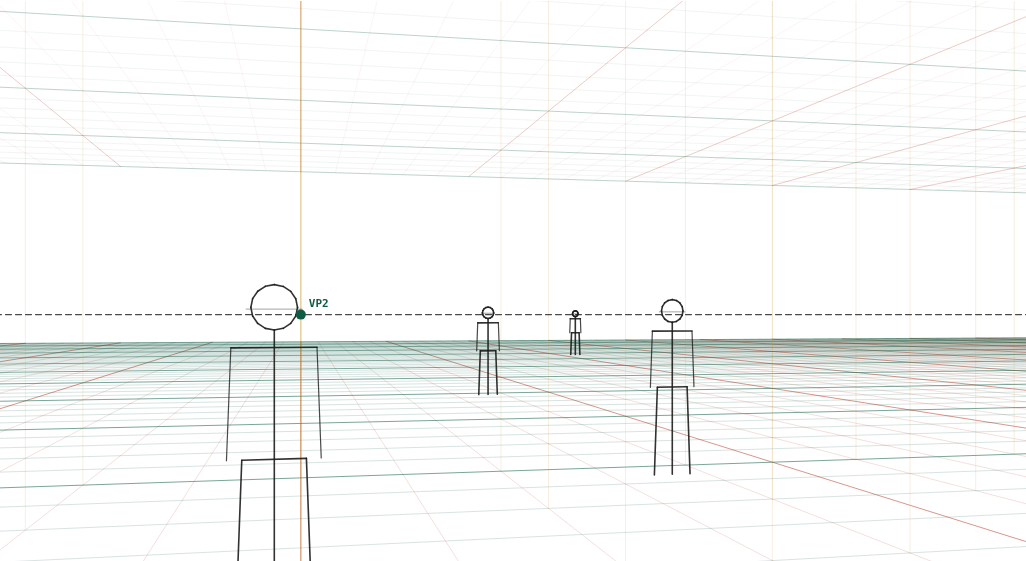
Four 1.75 m figures at 5, 10, 20 and 40 m from a standing camera.
What to look at
All four heads are on the horizon: same height as the viewer, same floor.
Each doubling of distance halves the figure.
Feet mark the distance; heads never move. Draw the feet first.
What this scene is for
Four identical 1.75 m figures at 5, 10, 20 and 40 m. This is the reference to open when you are placing people in a drawing and want to know how big they should be, and it is the scene behind the site's figure height calculator.
The mistake it settles
Moving the heads. When everyone stands on the same ground and the camera is at standing height, every head lands on the horizon however far away the person is — only the feet move down the page. Drawing a distant figure with its head lower than a near one puts them on a hill.
The camera
| Lens | 35 mm on full frame |
| Camera height | 1.6 m above the floor (standing) |
| Rotation | 12° to the scene's axes |
| Tilt | level (verticals stay vertical) |
| Objects | 4 × 1.75 m figure |
| Floor | 1 m squares |
Measured off this render
Taken from the same camera model the tool draws with, on the 1340 × 754 PNG above.
| Angle of view | 54.4° across (35 mm on full frame) |
| Horizon | 422 px from the top, 56% of the image height |
| Depth-axis vanishing point | 393 px from the left edge |
| Width-axis vanishing point | 5,459 px beyond the right edge |
| Object | Distance | Height on the render | Below the horizon |
|---|---|---|---|
| 1.75 m figure | 5.1 m | 456 px | 91% |
| 1.75 m figure | 10.1 m | 228 px | 91% |
| 1.75 m figure | 20 m | 114 px | 91% |
| 1.75 m figure | 40.1 m | 57 px | 91% |
Draw it from these numbers
- Rule the horizon across the sheet at 56% of the picture height — 422 px down on this 754 px render. Every other line in the scene is measured from it.
- Two vanishing points on that line: 393 px from the left edge, and 5,459 px beyond the right edge — far enough out that you should match the grid angles instead of chasing it.
- Set the scale from the 1.75 m figure at 5.1 m: 456 px tall, with 91% of it below the horizon. That share is the camera height divided by the object's height (1.6 ÷ 1.75 m), and it is the same for every object of that height anywhere in the picture.
Open the reference in the tool to move the camera, change the lens, or add your own objects at real sizes; the share link keeps your version. Draw over the PNG at 30–50% opacity in any app with layers.
Question
Does the head-on-the-horizon rule work for children and seated people?
Not for them, no. It holds for anyone whose eyes are at the camera's height. A child's head falls below the horizon, a seated adult's lower still, and a person standing on a step rises above it. That is a feature: the difference is exactly how you show who is short, seated or raised.