Balcony, 5 m up
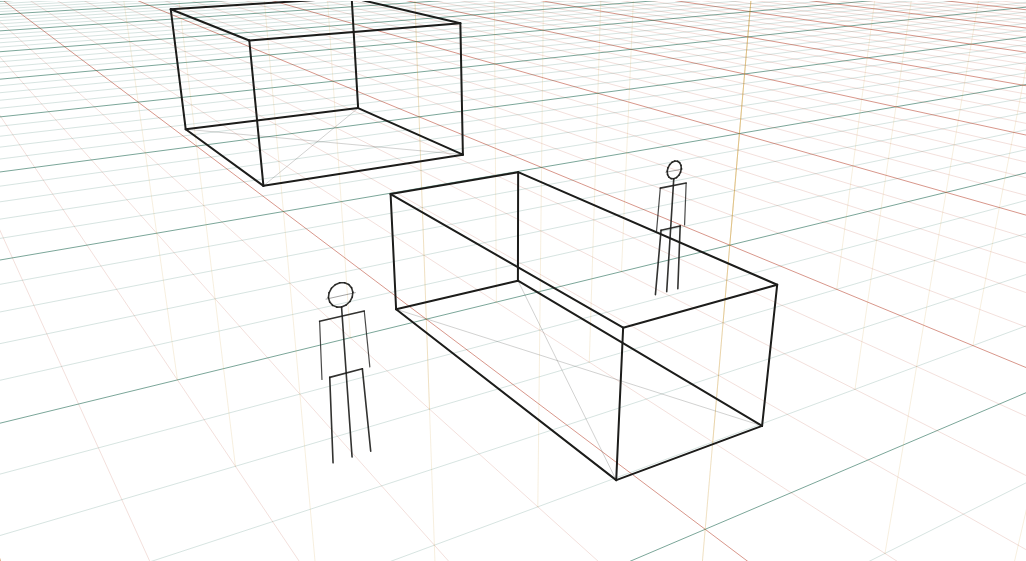
Two figures, a car and a shed from a balcony 5 m up, tilted 22° down.
What to look at
The horizon is just off the top of the frame; heads are far below it.
The car's roof and the shed's roof are fully visible: everything is below eye level.
Mild three-point: verticals converge downward, but gently, because the tilt is only 22°.
What this scene is for
Two figures, a car and a shed from a balcony 5 m up with a gentle 22° tilt. Use it for first-floor windows, terraces, stage views and low drone shots — high enough to look down on everything, not so high that the scene turns into a map.
The mistake it settles
Over-tilting. At 22° the verticals lean only slightly and the scene still reads as a view from a building rather than a plan. Doubling the tilt is a different picture entirely, and most balcony scenes are drawn with far more lean than the geometry calls for.
The camera
| Lens | 35 mm on full frame |
| Camera height | 5 m above the floor (elevated) |
| Rotation | 32° to the scene's axes |
| Tilt | 22° down (three vanishing points) |
| Objects | 2 × 1.75 m figure · 1.8 × 4.5 × 1.5 m block · 4 × 5 × 2.5 m block |
| Floor | 1 m squares |
Measured off this render
Taken from the same camera model the tool draws with, on the 1340 × 754 PNG above.
| Angle of view | 54.4° across (35 mm on full frame) |
| Horizon | 149 px above the top edge — outside the picture |
| Depth-axis vanishing point | 208 px beyond the left edge |
| Width-axis vanishing point | 1,579 px beyond the right edge |
| Vertical point | Nadir 2,847 px below the picture |
| Object | Distance | Height on the render | Below the horizon |
|---|---|---|---|
| 1.75 m figure | 8.1 m | 227 px | all of it |
| 1.8 × 4.5 × 1.5 m block | 10 m | 166 px | all of it |
| 1.75 m figure | 12.2 m | 170 px | all of it |
| 4 × 5 × 2.5 m block | 20.4 m | 164 px | all of it |
Draw it from these numbers
- The horizon is off the top of the picture, 149 px above the edge. Mark it on a larger sheet, or work from the grid: it is why every roof and every head is below you.
- Two vanishing points on that line: 208 px beyond the left edge, and 1,579 px beyond the right edge — far enough out that you should match the grid angles instead of chasing it.
- Nothing here is truly vertical: the uprights lean to a nadir 2,847 px below the picture.
- Set the scale from the 1.75 m figure at 8.1 m, 227 px tall on the render; the horizon passes above it, so it is shorter than the 5 m camera.
Open the reference in the tool to move the camera, change the lens, or add your own objects at real sizes; the share link keeps your version. Draw over the PNG at 30–50% opacity in any app with layers.
Question
When does a high view need three-point perspective?
As soon as the camera tilts. Any downward tilt sends the verticals to a nadir below the picture — here about 2,800 px below the bottom edge, which is a gentle lean. If the camera is high but level, verticals stay vertical and two-point still applies.