 by
by The difference between 1-point, 2-point and 3-point perspective is not a style choice. The number of vanishing points is decided by how the camera is placed relative to the box you are drawing, so the three types of perspective drawing are really three camera positions. Learn the questions below and you will never have to guess which one a scene needs.
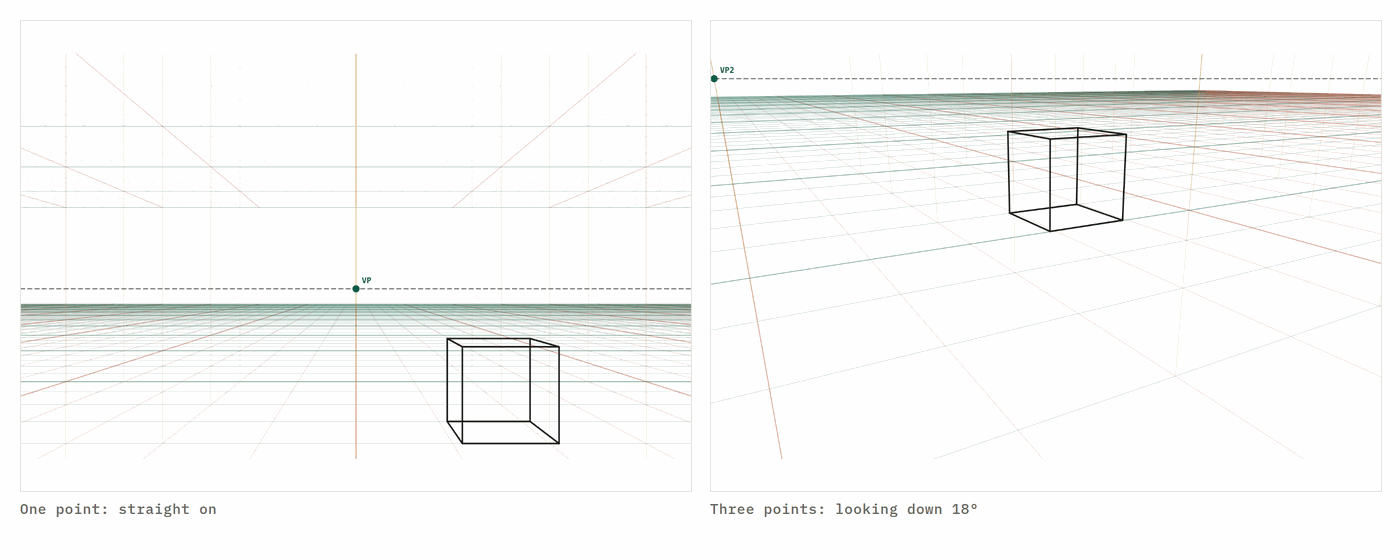
Question 1: are you square to it?
If you face a wall, a corridor or a road straight on, so that one face of the scene is parallel to your picture, you are in one-point perspective. Lines going away from you meet at a single point; everything else stays horizontal and vertical.
Typical one-point scenes: interiors seen from the doorway, streets seen down the middle, railway tracks, shelves and bookcases, the classic beginner's room.
Question 2: are you at an angle to it?
Turn a little to the side and the front face is no longer parallel to your picture. Now both sets of horizontal edges recede, to two points on the horizon. This is two-point perspective, and it is what most buildings, boxes, cars and furniture look like from wherever you happen to be standing.
Verticals stay vertical, which is the tell: if the vertical edges in your reference look parallel, two-point is enough.
Question 3: are you looking up or down?
Tilt the camera and the verticals begin to converge as well, toward a point above (zenith) or below (nadir). That is three-point perspective. Skyscrapers from the street, a courtyard from a balcony, a character seen from a drone.
The tilt does not have to be large. Even a 10° look-down adds a gentle convergence that makes a drawing feel photographed rather than diagrammed.
Question 4: is the view very wide?
Past about 90° of field of view, a flat picture plane starts to lie: things at the edges stretch. Real eyes and fisheye lenses do not do that; straight lines curve instead. That is curvilinear perspective, drawn with five points (180°) or six (360°).
Quick reference
| You see… | Perspective | Grid | |---|---|---| | A face of the subject parallel to the picture | 1-point | 1-point grid | | A corner of the subject, camera level | 2-point | 2-point grid | | A corner, camera tilted up or down | 3-point | 3-point grid | | A very wide or 360° view | curvilinear (4/5/6-point) | 4-point, 5-point or 6-point grid |
The lens matters as much as the count
Two drawings can both be two-point and look completely different because of the lens. A 20 mm lens puts the vanishing points close together and makes near objects loom; an 85 mm lens pushes them far apart and flattens everything. Every grid on this site shows the lens in millimetres so you can match a photograph, a film frame, or the feel you want.
Next: how to draw perspective from scratch if you are starting out, or three-point step by step.
Questions
Is 2-point perspective more realistic than 1-point?
Neither is more realistic; they describe different camera positions. One-point is correct when you face a surface squarely; two-point when you see it from a corner. Most photographs are two- or three-point simply because we rarely stand exactly square to things.
What is 4-point perspective?
A curvilinear grid with the vertical axis curved but the horizon straight, used for tall scenes seen from close. It is a special case of the 5-point fisheye grid; the site has a dedicated 4-point perspective grid page, and you can also approximate it on the curvilinear tool by keeping the view level.
What is the difference between one-point and two-point perspective?
Where you are standing, not how the drawing is styled. In one-point you are square to the face of the box, so that face stays a true rectangle and only the lines running away from you converge, to a single point. In two-point you are at an angle to the box, so no face is square to you and two sets of edges converge to two points on the horizon. Verticals stay vertical in both.
When should I use 1-point instead of 2-point perspective?
Use one-point when the subject genuinely faces you: a corridor, a road running straight away, a room seen from the doorway, a shelf viewed head-on. Use two-point the moment you can see two sides of something, which is most street scenes, most furniture and most buildings. If you are unsure, look at the subject and count the faces you can see.
Do I need a grid for every drawing?
No. Grids are training wheels and shot-planning tools. Use them when the scene has hard architecture, when a client needs accuracy, or when you are learning. Loose sketches only need the horizon and a rough idea of where the points are.
A new lesson and a new grid, about once a month.
Each lesson arrives by email before it goes on the site, with the grid it was drawn on and the link to open it. Subscribers also get both free starter packs and the subscriber price on the paid ones. Never more than two emails a month; one click to leave.
Handled by Kit on our behalf. Your address is used for this letter and nothing else — see the privacy page.